Noza for schools and courses
Online classes students show up and speak up in.
Free to start · No card needed · Set up in minutes
What’s in it for you
What you get as a teacher

- 1
A class that’s actually there
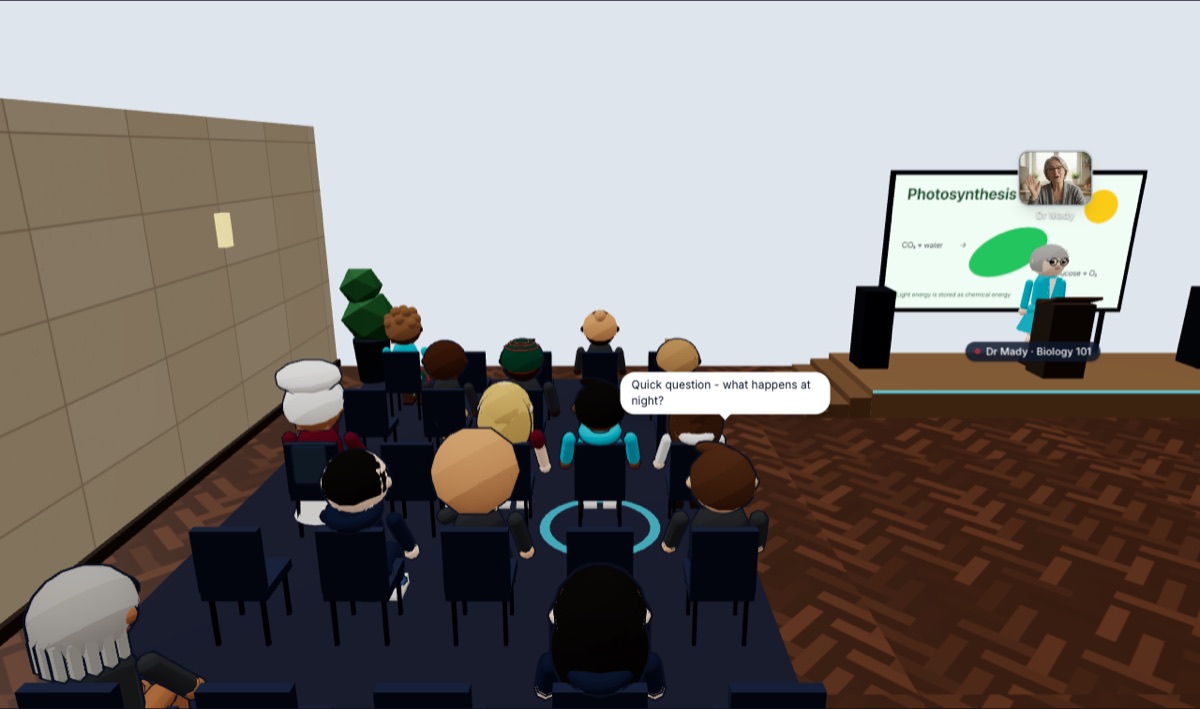
Students are in their seats in front of you, not black squares. You can see who came and where they’re sitting.
- 2
Students who talk
An avatar takes away the “how do I look?” worry that keeps cameras off and mouths shut.
- 3
Group work in seconds
Each side of the room is its own conversation already. No breakout rooms to build, no students lost in the shuffle.
- 4
Pay for teachers, not students
Teachers are seats, at £5 a month. Students are your audience, priced by how many are in at once, not per head.
The problem
Online lessons lose the classroom
On a video call, a class becomes a grid. Cameras go off, nobody wants to unmute, and group work means waiting to be sent to a breakout room.
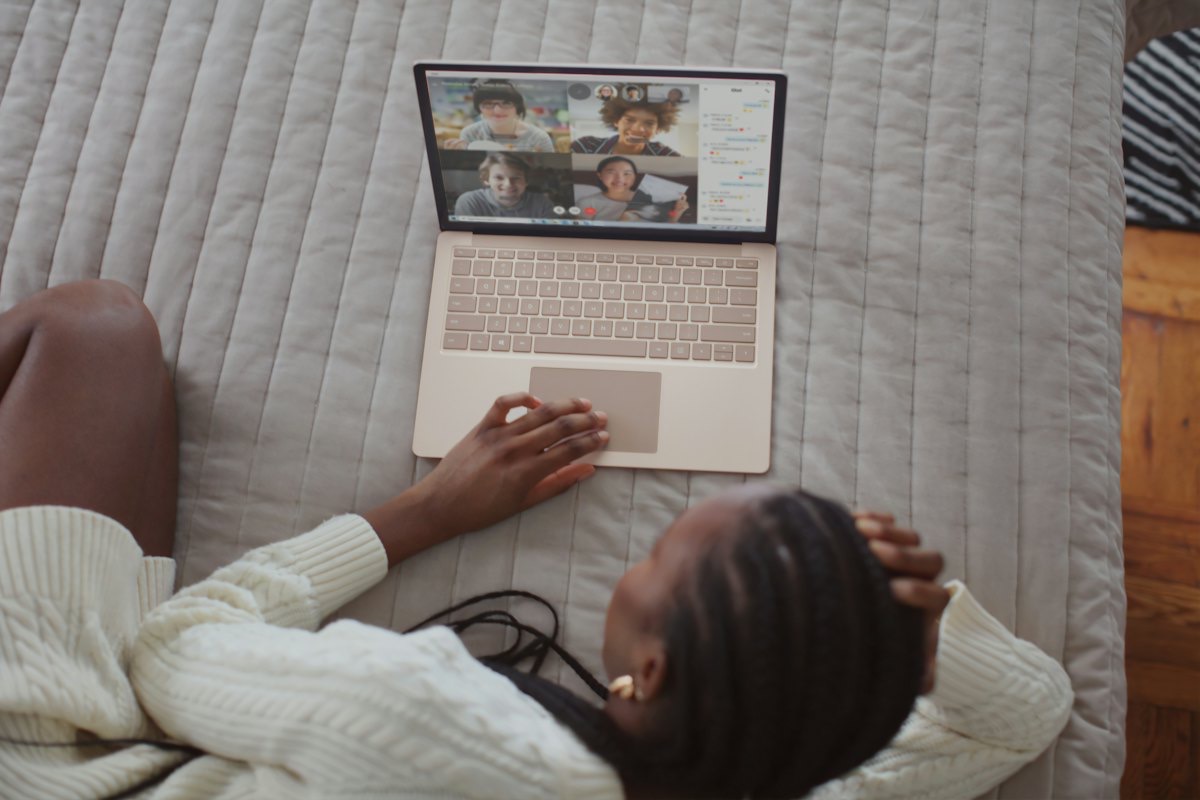
Cameras off, attention gone
Teachers talk to black squares and can’t tell who’s following.
Too awkward to speak
Unmuting in front of thirty silent tiles stops most students asking anything.
Group work is admin
Making breakout rooms, sorting students and pulling them back eats into the lesson.
What the research says
- 41%
of students who kept their cameras off in online classes said it was because of how they looked.
Castelli & Sarvary, Ecology and Evolution (Cornell), 2021 ↗ - 3%
of people who signed up to self-paced online courses finished them in 2017–18. Learning alone doesn’t stick.
Reich & Ruipérez-Valiente, Science, 2019 ↗ - 4
reasons video calls wear people out: close-up stares, watching yourself, being stuck in one spot, and working harder to read each other.
Bailenson, Technology, Mind, and Behavior (Stanford), 2021 ↗
If nothing changes
What a silent class costs you
- You can’t tell who’s lost until the assignments come in.
- Quiet students who never ask a question fall behind, and some don’t come back.
- You spend lesson time running breakout rooms instead of teaching.
Noza or a video call?
- Being there
- Students are in their seats as avatars. Cameras are optional.
- A grid of tiles, often with cameras off.
- Asking questions
- Speak up from your seat, like in a classroom.
- Raise a hand and wait to be unmuted.
- Group work
- Each side of the room is its own conversation. Nothing to set up.
- Breakout rooms to create and assign.
- Between lessons
- The classroom stays open for study groups.
- The meeting ends.
- Who gets in
- A private building only your students and staff can enter.
- Whoever has the link, unless you lock it down.
- Pricing
- One monthly price for the building, whatever the class size.
- Per teacher, per month.
Teaching that feels like teaching
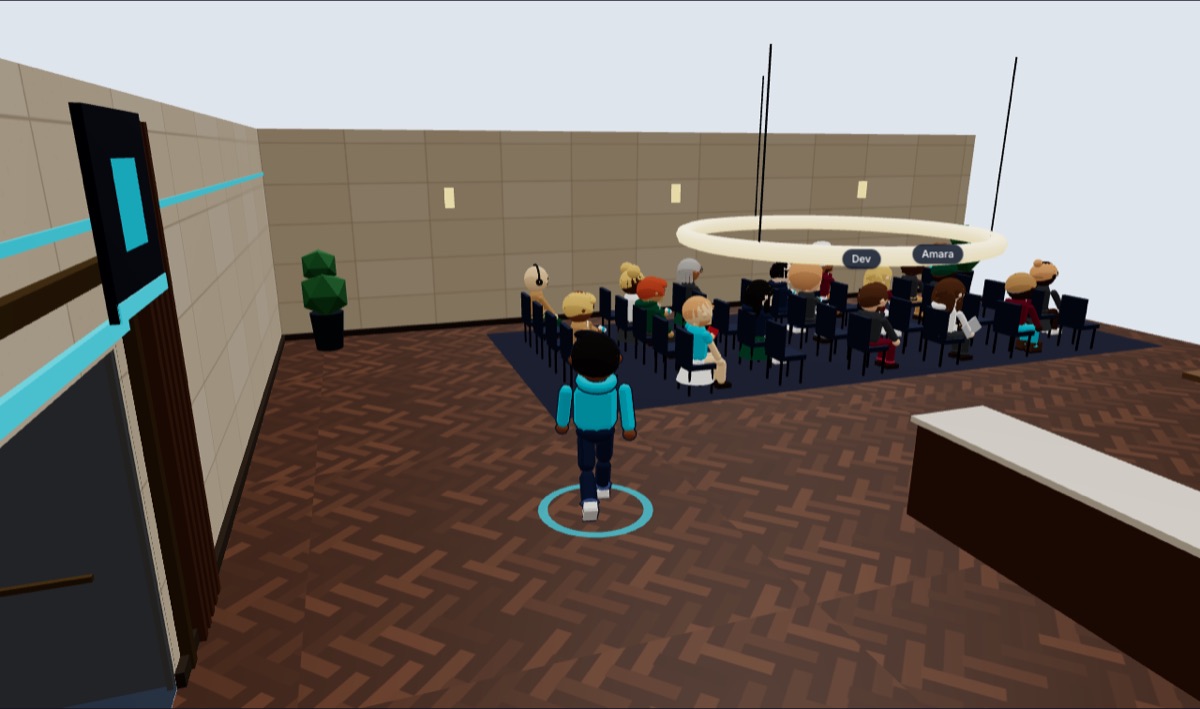
A real classroom
Your school gets a building with a stage at the front and rows of seats. Students walk in, sit with their friends, and the lesson starts.
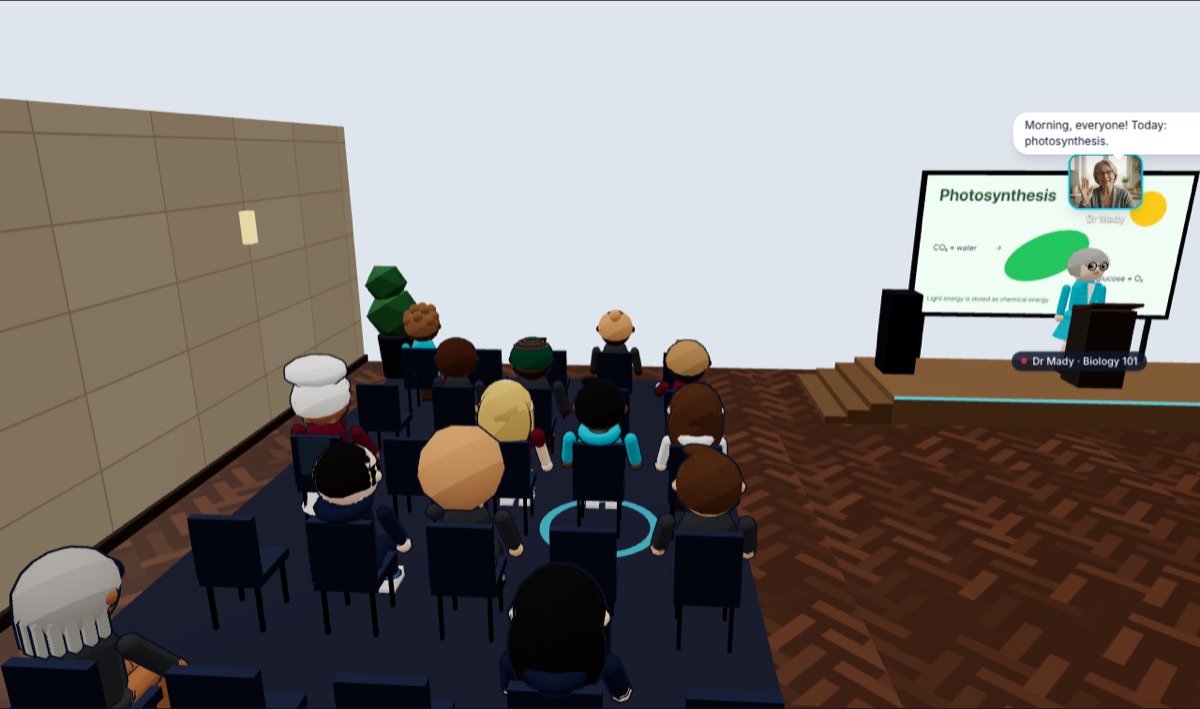
The teacher is heard
The teacher takes the room mic, and every student hears one clear voice. Hand the mic to a student when it’s their turn to present.
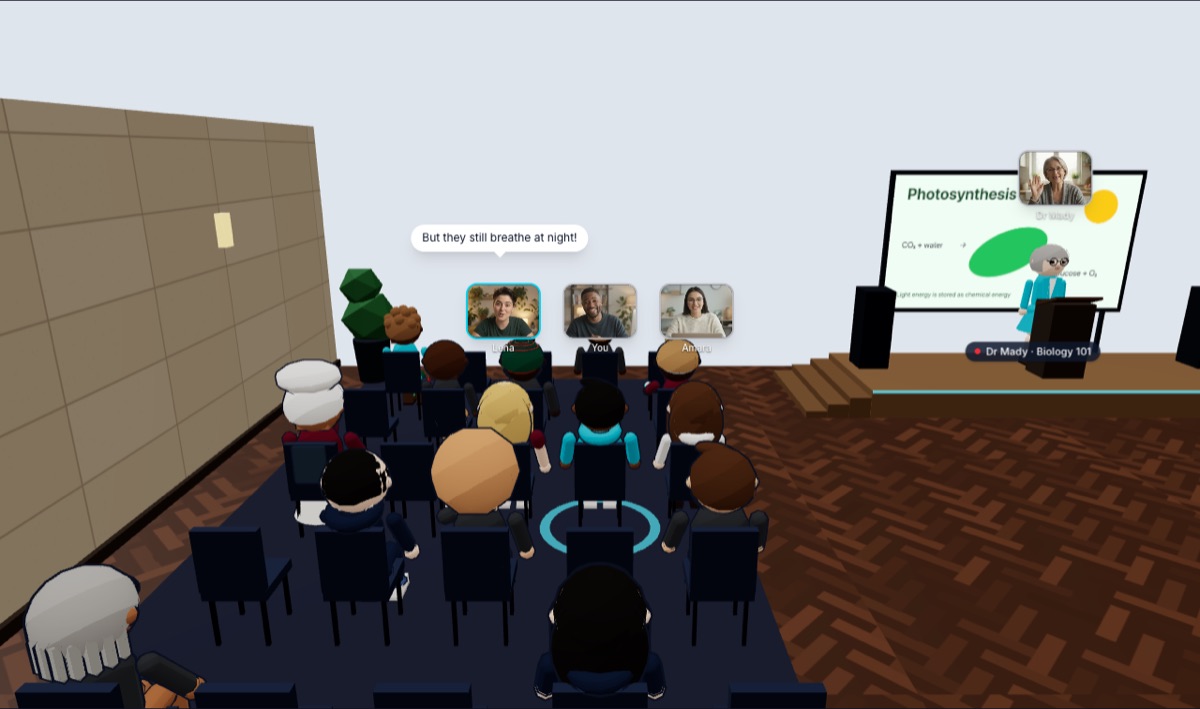
Group work in seconds
Students talk with the people on their side of the room. Switch back to the room and everyone’s listening to you again.
Private by default
Make your school private, and only the students and staff you approve can get in.
Getting started
Teach your first class next week
- Step 1
Set up your school
Free, in a couple of minutes. Walk round the city and try it out.
- Step 2
Start your plan
Seats for your teachers and an audience for your class. Pick the hall layout, with a stage and rows of seats.
- Step 3
Send students the link
They make an avatar, walk in and sit down. You take the mic.
Free to start · No card needed · Set up in minutes
Pricing
Pay for your team and your audience. That’s it.
Seats are for the people who run things, at £5 a month each. Audience is everyone else, priced by how many are in at once. Venues and your own building come with it.
Seats
£5 each a monthOwners, admins and hosts: whoever presents, sells, teaches or runs the place. Guest speakers don’t need one.
Audience, at once
Members, attendees, students, guestsHow many can be in your building and events at the same time. People who aren’t in don’t count.
Your bill
- 10 seats × £5
- £50
- Audience: 500 at once
- £149
- Total
- £199 a month
That’s a school with 10 teachers.
Start freeFree up to 10 people at once · No card to start · Cancel any time
What people pay
- One big event? Take a bigger audience just for that month. It goes back on its own.
- Selling tickets or memberships? On a plan, it’s all yours: Noza takes nothing, just card fees. On the free plan, Noza keeps 5%.
- Just you? One seat, £5 a month: an office of your own for calls. Noza Personal
Prices in GBP, excluding VAT. Card fees on ticket and membership payments are Stripe’s, passed on at cost.
You might be wondering
Do people need their cameras on?
No. Everyone is an avatar with a voice, so nobody has to worry about how they look or what’s behind them. Cameras are optional, and when they’re on they show over people’s heads.
Will students take it seriously?
It’s a classroom, not a game: rows of seats, a stage and a screen, with the teacher holding the room mic. There’s nothing to play and nothing to win.
Do we pay per student?
No. Students are your audience, priced by how many are in at once: 100 for £49 a month, 500 for £149. Teachers are £5 a month each.
How big can a class be?
A building holds 25 to 800 people. Bigger buildings work out cheaper per student.
Does anyone need to install anything?
No. Noza runs in the browser on a laptop or a phone. People make a free account and an avatar, and walk in. It takes about a minute.
Bring your class together
It’s free to set up and there’s no card to enter. Run one lesson in Noza and count the questions.
Start freeFree to start · No card needed · Set up in minutes